Important : During your thesis, you must take a course on scientific integrity and research ethics. You will not be allowed to defend your thesis if you do not.
Similarly, it is now mandatory to undergo training to raise awareness of gender-based and sexual violence, discrimination and harassment.
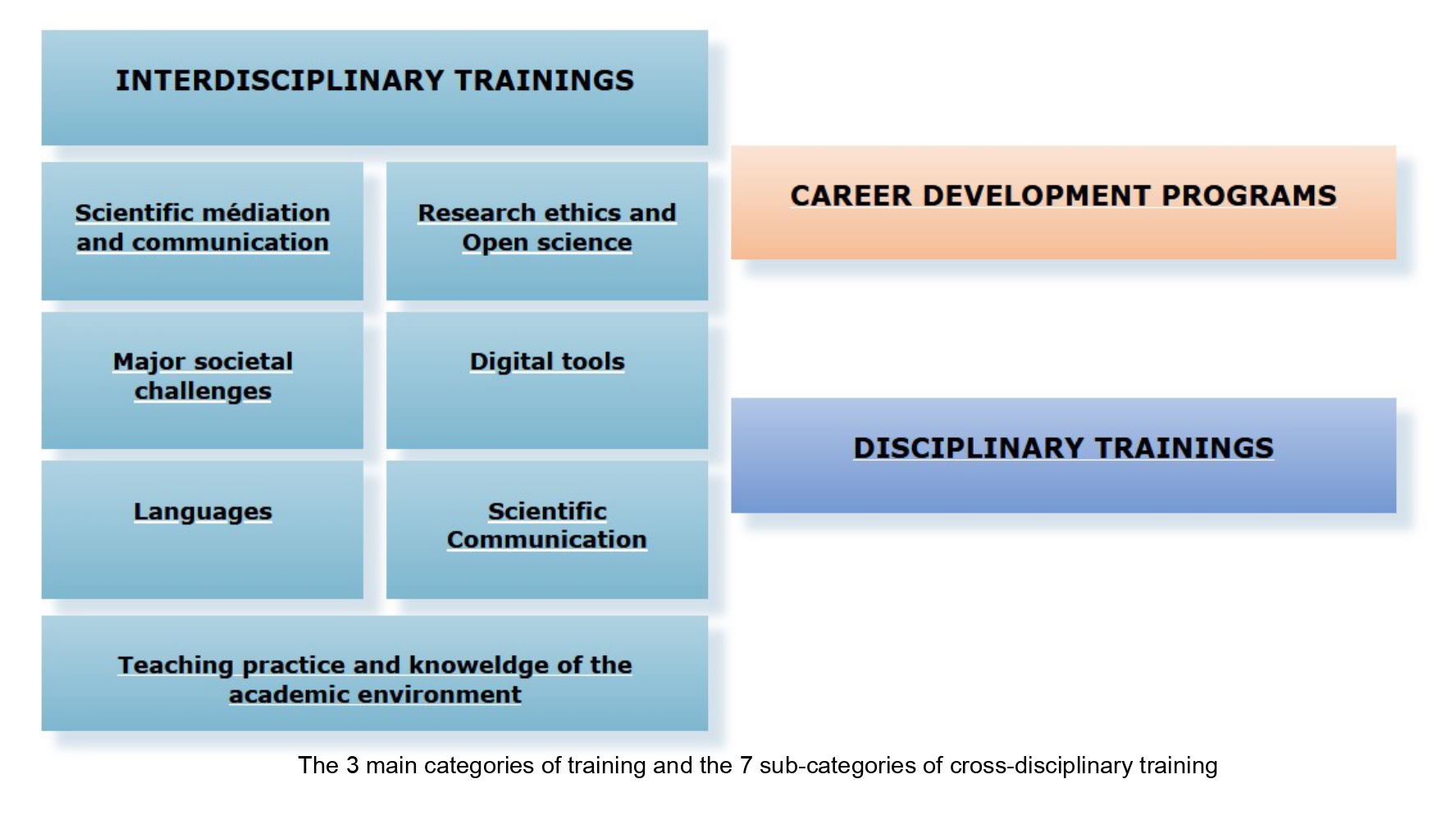
During their thesis, doctoral students must complete and broaden their training by taking various types of doctoral courses. This doctoral training can take many forms, in agreement with the thesis supervisor, and possibly the director of the École doctorale de physique for those that go beyond the usual framework. More than an obligation, this requirement for training during the thesis should be considered by the doctoral student as a right and an opportunity : it is training that complements the research work. In order to benefit from a varied and relevant training programme, we ask you to take at least two courses in each of the three main categories.
120 hours totalled over the duration of the thesis constitute a minimum to be authorised to defend the thesis and are made up as follows:
1/3 scientifics courses (40 hours) : these courses, managed by the Doctoral School, are chosen by the doctoral student and his/her thesis supervisor. Each year, the physics doctoral school offers doctoral students a range of scientific courses, but it is also possible to take courses offered by other doctoral schools. Numerous other courses can be offered by thesis partners to meet the individual needs of doctoral students.
1/3 cross-disciplinary courses (40 hours) : these courses are divided into seven sub-categories (researcher's activity and environment, research ethics, major societal challenges, digital tools, languages, scientific mediation and communication, teaching practice and knowledge of the academic environment). These courses, which are mainly managed by the Doctoral College's Training and Career Development Department, are more general in nature and aim to support doctoral students, whatever their discipline, in their training to become researchers.
1/3 career-related courses (40 hours) : these courses are designed to facilitate the professional integration of future young doctors, whether they are destined for a career in academia or in the private sector.
The Université Grenoble Alpes Doctoral College and its Training and Career Development Department offer doctoral students a wide range of training courses (see the Doctoral College Catalogue section). Doctoral students can also take external training courses if these have been approved by their Doctoral School.
Course validation
For all courses offered in the Doctoral College's training catalogue and for which you must register on your personal ADUM account, validation will be carried out automatically by the organising department, once the teacher has sent you the attendance list and you have completed the questionnaire that will be sent to you. You do not therefore need to request a certificate of attendance.
For all other courses, you will need a certificate of attendance (you will find a template to download at the bottom of this page). You will then need to log in to your personal ADUM account and click on the link “Declaration of non-catalog courses.” You will then need to indicate :
the title of the course
the category (scientific training, cross-disciplinary training, career development),
the number of hours (up to a maximum of 40 recognised hours per course)
and download your certificate of attendance in PDF format only.
In addition to the scientific courses offered by the Physics Doctoral School, it is also possible to have these recognised as doctoral courses :
Summer and winter schools (French or foreign),
MOOCs (such as those on the FUN platform - France Université Numérique),
courses offered by other doctoral schools (at the UGA or elsewhere),
Master's courses (these must be complementary courses, not remedial courses in the event of failure)
and hours of teaching/TP provided during your thesis (see conditions in the box below).
This list is not exhaustive ; you may submit other training courses that you may have taken for the purposes of your thesis (the Physics Doctoral School reserves the right to accept them or not). Whatever the length of the course, the Doctoral School can only recognise a maximum of 40 hours for any one course.
Finally, you are reminded that the validation of non-catalogue hours is at the discretion of the management of the École doctorale de physique. This means that the volume of hours recognised is not necessarily equal to the volume of hours declared.
Getting teaching/tutorial hours recognized as PhDl training :
If you wish to have your teaching/PT hours recognised as doctoral training hours, you must take a teaching course related to teaching practice (see the Doctoral College catalogue - sub-category Teaching practice and knowledge of the academic environment). You may also have a course that is not listed in the catalogue validated. However, you are exempt from this requirement if you have passed a competitive teaching examination. The actuals courses are only given in French, but you are exempt from taking one if your level of French is not sufficient.
In addition, the 1/3 rule applies, with 1 hour of recognised training for every 3 hours of teaching/TP given, up to a maximum of 40 hours recognised for any one course. Recognised teaching hours are counted as training in the career development category.
Teaching/tutorial hours must be declared on your ADUM profile in the same way as any other non-catalog course. You must provide a certificate stating the number of hours completed (a certificate provided by the person responsible for the course you taught, for example).
However, not all courses taken during the thesis can be validated as doctoral courses:
Conferences, colloquia (with or without poster presentation), seminars or workshops are not validated as doctoral training. They are considered to be part of the ordinary work of a researcher.
Similarly, safety training is not part of doctoral training either, as it is compulsory for all laboratory staff.
Download
List of courses approved by the UGA Doctoral College [pdf]
Share the linkCopyCopiedClose the modal windowShare the URL of this pageI recommend:Consultable at this address:La page sera alors accessible depuis votre menu "Mes favoris".Stop videoPlay videoMutePlay audioChat: A question? Chatbot Robo FabricaMatomo traffic statisticsX (formerly Twitter)